
All of the sudden everybody Carla and Wolfgang knew was getting a 'dacha'. This was about a year after they moved from New York to Berlin. Another German-American couple got one in the west, near Wannsee. Two expat families landed plots in a garden colony in the former east. Wolfgang, Carla's west German husband, was not convinced. It meant, he said, that they were staying. Nobody bought a sandy lot featuring a cheap, asbestos-clad shack in the former GDR unless they were staying.
The one they bought at the end of the winter of 1999 looked like a lunar landing module, splashed down near a lake in the southeastern woods. To Carla it looked faintly Bauhaus, with its plate glass windows and wings holding up the cantilevered roof. The lake was part of a chain that curved around the city to the east, identical to the better-known string in the west. From the air these waterways enclosed Berlin like Rorschach lungs.
Wolfgang handled the transaction. He understood by then that follies of this kind were the price he paid for dreams she'd left behind. They were on their third diplomatic posting, or their fourth, if you counted Berkeley, where they had met in grad school, he in international relations, she in graphic design. Four countries, ten years, two kids. Carla had found the ad in the Berliner Zeitung and forced herself to make the call in her halting German.
"I am going just now to make the contract with a man," answered a woman identifying herself as Angelika, in equally fractured English. "But maybe it doesn't work." There was the slightest pause. "You are American, I think?" Angelika Brandt said to take a look, and if they liked the dacha, call her back. "I really shouldn't break the contract," she repeated to Wolfgang the next day. Carla mouthed that he should offer more. Her husband rolled his eyes, but he complied.
Carla believed that kids had to know the feel of grass between the toes. She'd been raised in a verdant California suburb. After Delhi and Manhattan, time was running out: Ellie was eight already, Thomas nearly five. From the little prefab bungalow they could wander barefoot down a sandy track to the scruffy bank of a shallow lake. They could skinny dip, and know the creepy thrill of unseen things beneath them in the dark green water.
Angelika had spent every summer of her East German childhood in the Bungalow HW-22 that would soon be theirs. But they signed the papers in a cottage with a cellar that had been her grandparents', across the lake. They drank coffee in her garden in the spring drizzle, slapping at mosquitoes the size of dragonflies. Angelika and her partner, Manny, had a boy Thomas's age called Markus; they bridged the language gap with dirt and matchbox cars. Ellie sat saucer-eyed in Wolfgang's lap, the two of them recoiling slightly beneath the flowered awning.
A little bit about Alix Christie
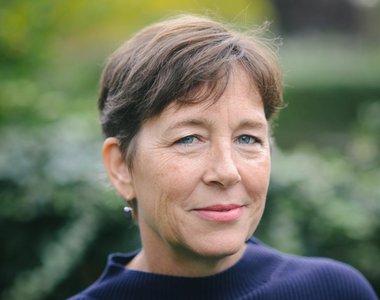
Alix Christie is a journalist, printer and author based in London. A dual citizen of the U.S. and Canada, Alix read philosophy at Vassar College and holds a master’s degree in journalism from the University of California at Berkeley and a masters of fine arts from St. Mary’s College of California. Her career as a newspaper reporter and foreign correspondent began in her native northern California and has taken her to France, Germany, and England. She has reported from Europe for the Guardian, San Francisco Chronicle, Salon.com, Washington Post and many other publications. She currently lives in London with her husband and two children, while her Chandler & Price letterpress resides in San Francisco. When not writing she swims in the Serpentine in Hyde Park, haunts the London Library and contributes book and arts reviews to The Economist.
Her debut novel, “Gutenberg’s Apprentice”, was published by Headline in Great Britain and Harper Books in the United States in 2014. The story of the invention of printing and the making of the Gutenberg Bible, it has been longlisted for the 2015 International Dublin Literary Award and translated into half a dozen languages. Her shorter fiction has been honoured in both the U.S. and U.K. A novella, “Motherland”, was runner-up in the 2015 Novella Award sponsored by Manchester Metropolitan University and Liverpool John Moores University. A short story won her the 2011 McGinnis-Ritchie award for fiction from the Southwest Review, one of America’s oldest literary reviews.